


A five-year retrospective of the Lancang-Mekong Sweet Spring Project
Water is the source of life and the foundation of health. Whether it is drawing clear spring water from the mountains or drilling deep wells for sweet water, building convenient access points or installing purification equipment in homes and schools, these seemingly simple public welfare projects are quietly transforming daily life in rural communities across the Mekong River countries.
Sharing the same river, the well-being of people living in the Lancang-Mekong River basin is closely intertwined. In 2016, the Lancang-Mekong Cooperation mechanism was launched, outlining a blueprint for shared regional development. Since 2020, with support from the China-Asia Cooperation Fund, the China Institute of Water Resources and Hydropower Research, the Lancang-Mekong Water Resources Cooperation Center, and the Changjiang River Scientific Research Institute of the Changjiang Water Resources Commission of the Ministry of Water Resources, the Lancang-Mekong Water Supply Initiative has been jointly implemented. The initiative focuses on addressing safe drinking water challenges in rural areas across Cambodia, Laos and Myanmar. By the end of 2025, a total of 110 "small but beautiful" water supply demonstration projects had benefited approximately 13,000 people, turning the vision of "building a Lancang-Mekong community with a shared future" into real smiles on villagers' faces.
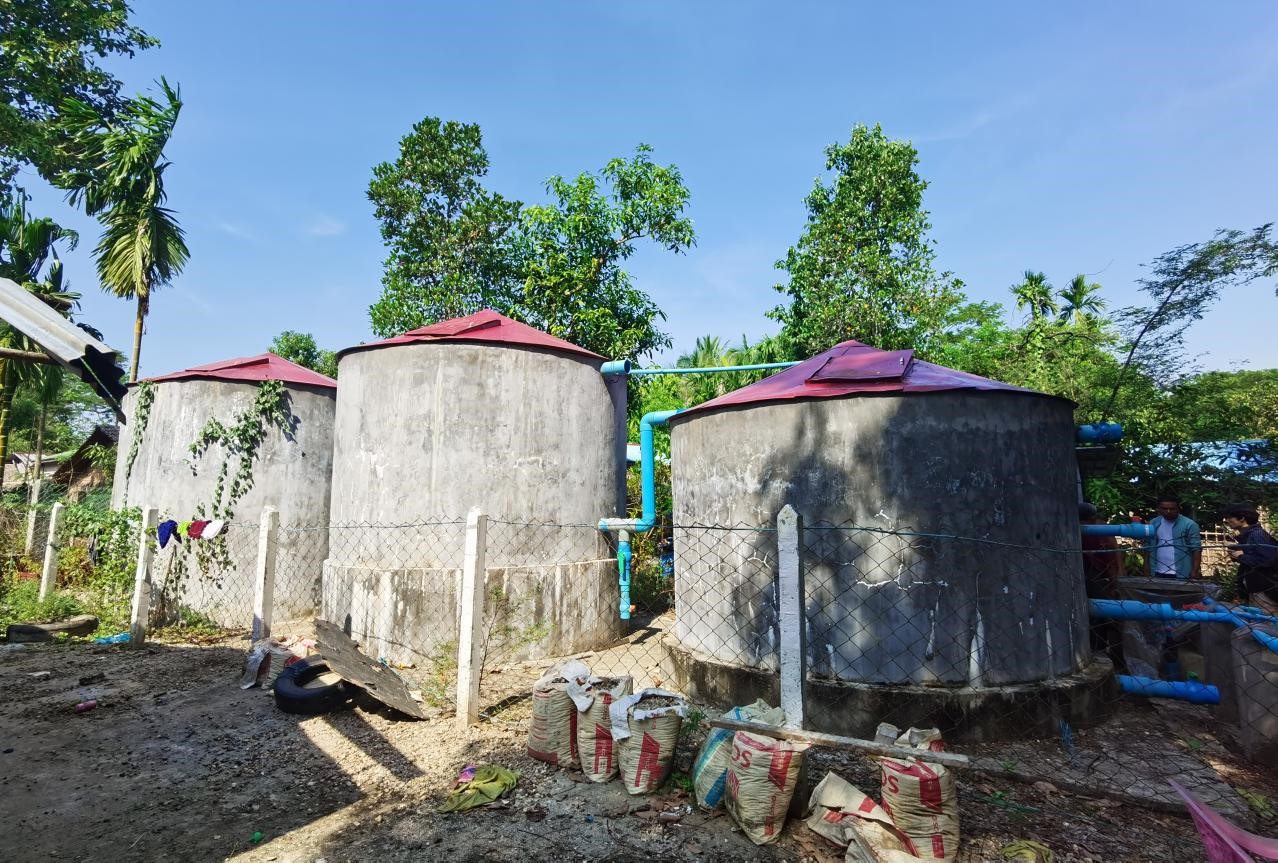
A demonstration project in Maubin village, Ayeyarwady, Myanmar.
Targeted solutions to address urgent water needs
In the past, residents of Hatkip village in Luang Prabang province, Laos, were frequently embroiled in disputes with neighboring villages over water resources. In Myanmar's Rakhine state, residents often suffered from diarrhea caused by drinking muddy water during the rainy season and algae-contaminated water during the dry season. In Sleng village, Kandal province, Cambodia, children had to walk half an hour each day to fetch water from shallow wells at a temple. These situations reflect common water-related challenges faced by rural communities in Cambodia, Laos, Myanmar and beyond: insufficient water supply, poor water quality and inconvenient access.
Faced with complex natural environments and diverse baseline conditions, "adapting to local conditions" became the key to success for the Lancang-Mekong Sweet Spring Project team.
In the mountainous areas of Luang Prabang and Phongsali provinces in Laos, extensive field surveys, on-site inspections, water volume assessments and water quality testing were conducted to identify reliable, high-quality spring or well water sources. Gravity-fed water supply systems were then constructed in line with local terrain, using locally sourced river sand as filtration material. This low-energy, low-maintenance model effectively ended the long-standing problem of water shortages during the dry season and turbid water during the rainy season.
These flowing springs have nourished the lives of thousands and deepened the roots of China-Laos friendship. In the plains of Stung Treng and Kandal provinces in Cambodia, deep wells and elevated water storage tanks were installed to mitigate dry-season water shortages. At the same time, a multi-stage barrier system combining natural geological filtration, activated carbon adsorption and ultrafiltration membranes was introduced, delivering high-quality drinking water at a low cost. Villagers highly praised the resulting "healthy and good water."
In Kyaukphyu district of Rakhine state, Myanmar, the project team built an innovative four-stage biological slow filtration system using local river sand and coconut shells. Designed to respect local customs and operating costs, the system achieved the remarkable result of transforming turbid water into clean water without the use of chemical agents.
Improved water access methods also bridged the "last mile" of supply. Centralized water collection points and water dispensers now ensure universal, equitable access to clean, convenient and affordable drinking water. Duk Sras, principal of Ang Sleng Primary School, noted that students previously had to bring water from home each day. Now, teachers and students can drink directly from the centralized water point, and some even take water home after school. "The water is very clean and tastes sweet," he said. Erik, a villager from Hatkip village in Laos, no longer has to spend hours fetching water or purchase bottled water, while children can now drink safe water directly at school— something once unimaginable.
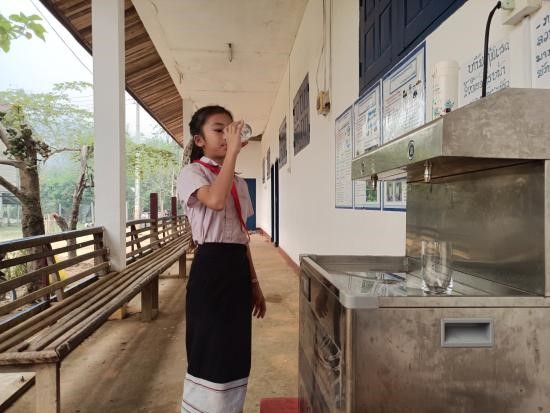
A student drinks clean water at Hatkip Village Primary School, Luang Prabang province, Laos.
Rooted in symbiosis, empowering governance
"The best technology should be like rice seeds, taking root and sprouting in foreign lands"— this philosophy has consistently guided the Lancang-Mekong Sweet Spring Project. Rather than simply exporting technology, the project has built a deeply integrated model of "Chinese technology plus localized management," tailoring technical solutions to local natural conditions while embedding humanistic care into engineering practices.
Before each project was implemented, thorough research and democratic consultations were carried out. In Hatkip village, more than 80 local representatives and Chinese experts jointly voted on key issues such as construction plans, management models and cost sharing. Community members participated throughout planning, construction and management, strengthening their sense of ownership and responsibility for long-term maintenance. When Chinese Minister of Water Resources Li Guoying inspected the project in April 2023, he praised it for its clear objectives, sound design, strong multi-party cooperation, effective implementation, and positive public feedback.
This participatory management approach has since been refined in Cambodia, Myanmar and elsewhere. In Sleng village, Cambodia, the project team established a three-pronged operation and maintenance mechanism based on "project guidance, village self-governance and reliance on temples." Villagers elected dedicated water managers, while daily operation and maintenance were entrusted to the local temple, creating a low-cost, sustainable model with clearly defined responsibilities. Minister Li emphasized that "the importance of mechanism design is no less than that of engineering construction." Watt Botkosal, deputy secretary general of the Cambodia National Mekong Committee and the Cambodian coordinator of the project, noted that the Sweet Water Action project has not only improved livelihoods but also strengthened local management capacity, supporting Cambodia's goal of achieving universal access to safe drinking water by 2030.
The project's long-term value is also reflected in knowledge and skills transfer. In Myanmar, targeted technical training was provided, local water managers were cultivated, and easy-to-understand maintenance manuals were compiled in Burmese. Complex operational procedures were translated into practical, memorable guidance, naturally integrating into daily community life.
Beyond delivering 110 water supply projects, the Lancang-Mekong Sweet Spring Project has offered a comprehensive solution encompassing precise needs assessment, tailored design, sustainable operation and local capacity building. Over the past five years, more than 200 professional managers have been trained, and over 400 people have participated in community science outreach activities, achieving a shift from "hardware assistance" to "knowledge empowerment."
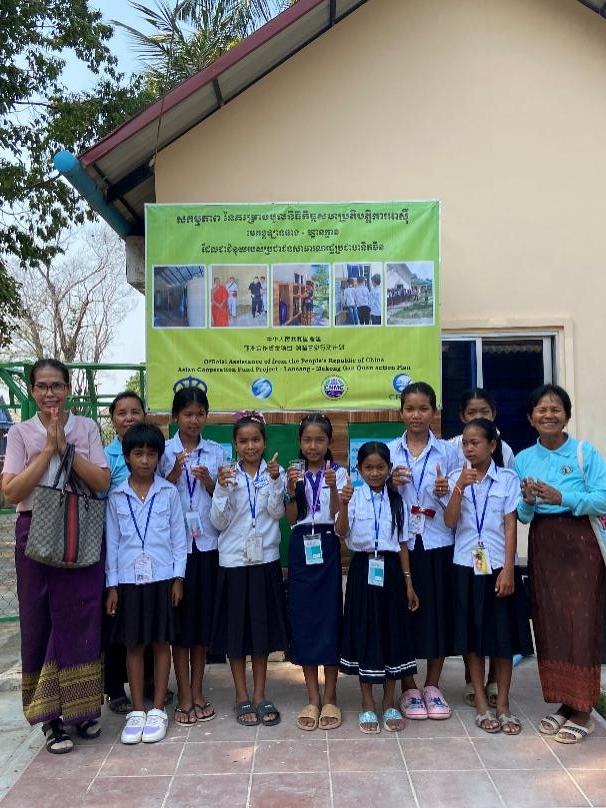
Students and teachers now have access to clean drinking water at Sleng Village Primary School in Kandal province, Cambodia.
Fostering mutual understanding and showcasing the Chinese approach
All 110 "small but beautiful" projects have won genuine public support. Surveys show that more than 95% of users are satisfied with water quantity and quality, 93% report significantly lower household water expenses, and 91% have been freed from having to travel long distances to fetch water. Local governments in Laos, Cambodia and Myanmar have sent letters expressing gratitude regarding the initiative that is delivering tangible benefits. Souk An Bounyong, then deputy secretary of the Provincial Party Committee of Luang Prabang and chairman of the Front for National Construction of Lao PDR, said at the Hatkip village handover ceremony that the project has benefited nearly a thousand residents, teachers and students, adding that he hopes China-Laos friendship will endure for generations.
International recognition has followed. In 2023, the project was included in the practical cooperation list of the Third Belt and Road Forum for International Cooperation. In 2024, it won the fifth "Global Best Poverty Reduction Case" award jointly issued by seven institutions, including the World Bank and the Food and Agriculture Organization of the United Nations.
From villagers' smiles to government gratitude, and from international forums to global awards, these achievements affirm both the Lancang-Mekong Sweet Spring Project and the broader vision of building a community with a shared future for the Lancang-Mekong region. Safe drinking water is fundamental to sustainable development. As the United Nations 2030 Agenda for Sustainable Development emphasizes universal access to safe and affordable drinking water, this vision is steadily becoming reality along the Mekong River.
At sunset, villagers gather at water points; in classrooms, students turn on faucets with bright curiosity in their eyes. These ordinary yet moving moments form a heartwarming scene. Born from Chinese wisdom and solutions, the Lancang-Mekong Sweet Spring Project is benefiting thousands of households today and will continue to nourish lives across the basin for years to come.